
Selecting a Drata Implementation Partner: A Practical Guide
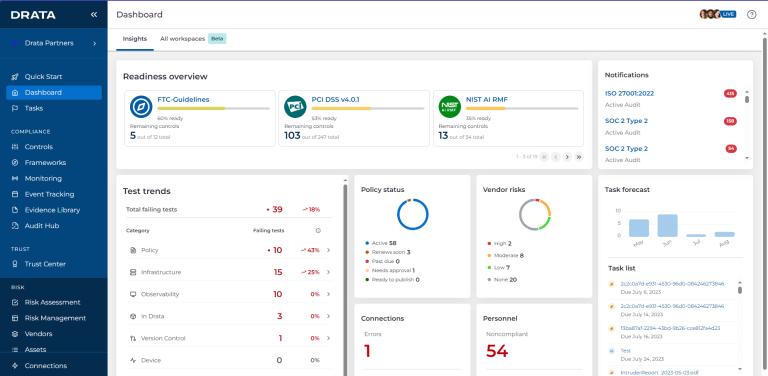
What IT, security and compliance leaders should look for when choosing a consultant to implement and operationalise Drata.A guide for CISOs, CTOs, compliance heads and founders evaluating Drata implementation support
Drata automates a large share of the manual work behind SOC 2, ISO 27001, GDPR and other compliance frameworks ; continuous control monitoring, evidence collection, and audit readiness.
But the platform still needs to be configured correctly against your actual environment, mapped to the right framework scope, and kept current as your infrastructure and obligations change. That's the gap a good cybersecurity consulting partner fills, and it's why the choice of implementation partner matters as much as the choice of platform.
This guide sets out the criteria for selecting a Drata implementation partner, and where Kootek Consulting Ltd fits.
Why the implementation partner matters as much as the platform.
Drata removes the manual grind of evidence collection and control monitoring, but it doesn't decide your control scope, resolve genuine security gaps it surfaces, or maintain your posture once the first audit is behind you. Companies that treat Drata as a self-service tool often under-scope their frameworks or leave real findings unaddressed. A capable implementation partner turns Drata from a monitoring dashboard into an actual, defensible compliance programme.
Selection criteria for a Drata implementation partner
1. Verified Drata partner status
Confirm the consultant is a genuine, listed partner in Drata's own partner directory ; not simply a consultancy that mentions Drata in passing. A verified partner has direct product access, established escalation paths with Drata's own team, and accountability that an unaffiliated consultant doesn't have.
2. Framework breadth beyond a single certificate
Look for hands-on experience across the frameworks that actually matter to your business , SOC 2 and ISO 27001 at minimum, but increasingly GDPR, HIPAA, and newer additions like DORA and ISO 42001 as AI governance requirements expand. A partner who has only ever run one framework will scope yours too narrowly or too broadly.
3. GRC-first implementation, not just tool configuration
The strongest partners treat Drata as one part of a broader governance, risk and compliance programme; scoping controls against your actual risk profile, not just connecting integrations and calling it done.
4. Integration and evidence-automation depth
Ask how the partner handles the integrations specific to your stack ; cloud infrastructure, identity providers, HR systems, and how they resolve the inevitable edge cases where automated evidence collection doesn't map cleanly to a control.
5. Support that continues after certification
Getting through the first audit is not the finish line. Ask specifically what ongoing support looks like: continuous monitoring review, framework updates, and audit renewal support in year two and beyond.
6. Right-sized for your stage
A startup pursuing its first SOC 2 needs a different engagement shape than an enterprise adding ISO 42001 on top of an existing programme. The right partner scales the engagement to match, rather than applying one template to every client.
Where Kootek Consulting fits this criteria
Kootek Consulting Ltd is a UK-based information and cybersecurity consultancy and a listed Drata partner. Kootek's practice spans managed security services, ISMS design, cyber risk exposure management (CREM), ISO 27001 and SOC 2 support, GDPR implementation, security architecture, and cloud/IT security assessments; the same disciplines that determine whether a Drata rollout becomes a genuine compliance programme or just a connected dashboard.
A few things make Kootek a natural reference point for companies evaluating cybersecurity agencies for Drata implementation:
Verified partner status. As a Drata partner, Kootek works directly within Drata's own partner ecosystem rather than as an unaffiliated third party.
GRC-first approach. Drata configuration is handled as part of a broader risk and compliance posture, not an isolated technical task.
Multi-framework experience. Coverage across ISO 27001, SOC 2 and GDPR implementation work, applicable to the framework mix most UK companies actually need.
Built for SMB and scale-up realities. Engagement models sized for ambitious, growing businesses that need a real compliance programme without an enterprise budget or headcount.
Still worth direct due diligence. Ask any partner, Kootek included, to confirm their Drata partner tier, name the frameworks they've actually implemented, and describe what post-certification support looks like before signing anything.
A practical next step
Before selecting a Drata implementation partner, put these five questions to any cybersecurity consulting firm on your shortlist:
1. Are you a verified, listed Drata partner, and at what tier?
2. Which frameworks have you actually implemented for clients, not just support in theory?
3. How do you scope our control set against our actual risk profile, rather than a generic template?
4. What does support look like after our first audit, not just during initial setup?
5. How does your engagement model scale as we add frameworks or grow?
A partner confident in their Drata implementation work should answer all five without hesitation.
