
Which online cybersecurity training supports role-based learning paths ? and why it matters.
By Dr.Amon | Online education specialiest | 18th September 2026
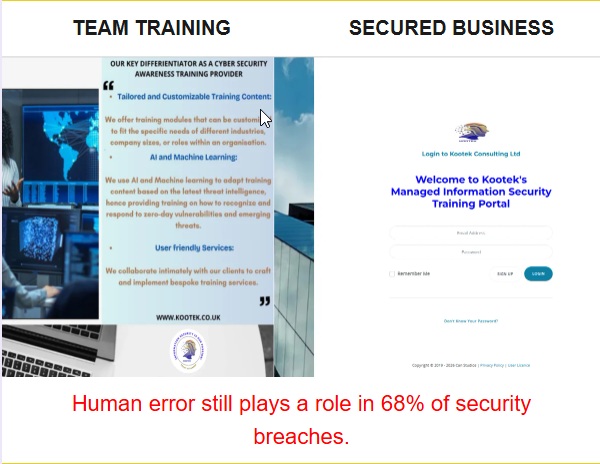
In today's threat landscape, a uniform approach to cybersecurity awareness is no longer adequate. Research consistently indicates that most data breaches result from human error, and generic annual training does not address the specific risks associated with different organisational roles.
A finance team member faces invoice fraud and payment diversion scams, a developer with production access is targeted for secrets exposure and insecure code, and a receptionist face entirely different risks while an executive is a prime target for Business Email Compromise (BEC) and CEO impersonation. Training them all identically is the single biggest reason awareness programmes underperform because training all four identically means over training some people and under preparing others . Role-based training ensures that every employee receives guidance directly relevant to the risks they actually face.
This blog post examines why role-based cybersecurity training is essential, and what to consider when selecting a provider that actually delivers them.
Why role-based training is paramount
The case for role-based training isn't theoretical. The UK Government's own Cyber Security Breaches Survey makes the scale of the human-factor problem clear, year after year:
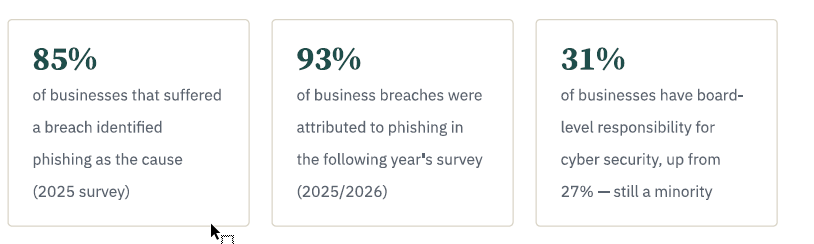
Phishing is not a technological failure but a human one, and it is by far the leading cause of breaches in the UK. However, employees are not all targeted in the same manner, nor do they face the same consequences.
A phishing email targeting a payroll administrator differs significantly from one directed at a systems administrator, and the impact if either is engaged is substantially different. Generic training instructs all employees to identify the same limited set of warning signs, despite the fact that the attacks encountered across different roles vary considerably.
Role-based learning paths address this gap by aligning content, depth, and delivery frequency with actual risk exposure: more advanced, technical training for high-access roles such as IT administrators and developers; finance-focused modules addressing invoice fraud and payment diversion for finance teams; data handling and privacy-oriented training for individuals processing personal data; and lighter, more frequent awareness refreshers for general staff. It also ensures that training scales appropriately as employees move between roles, rather than requiring every individual to complete the same static annual module regardless of their current responsibilities.
Evidence from real-world implementations
National Grid’s approach serves as a useful example. The organisation redesigned its cyber awareness programme to provide role-specific, behaviour-oriented learning to 28,000 employees across the UK and US, ensuring the right people receive the right guidance, based on the risks they actually face. This resulted in a structured, dual-stream learning model that balanced organisation wide consistency with highly targeted training for roles with elevated risk.
This approach illustrates how structured, scenario based learning can integrate high risk roles, behavioural insights, and leadership visibility within a single measurable framework.
Compliance and regulatory drivers
Regulatory requirements are placing growing emphasis on role-specific training. Guidance from the UK National Cyber Security Centre, the ICO’s training and awareness materials, and standards such as ISO 27001 all reflect a consistent operational reality: individuals require clearly defined expectations aligned to their roles.
Within the NHS, for instance, the Data Security and Protection Toolkit now requires that all staff have an appropriate understanding of information governance and cyber security rather than relying solely on completion of a single mandatory e-learning module.
What to look for when you compare providers
Key questions to ask before choosing an online training provider
Before you choose a provider, ask directly:
-Can learning paths be configured by role and risk level, not just department?
-Can completion and risk data be reported by role for audit purposes?
-Is content reviewed and refreshed regularly as attack methods change, or delivered once and left static?
About Kootek's Learning management platform
At Kootek Consulting, we specialise in information and cyber security consultancy, with a focus on human-centric security. Our training services are designed to address the specific needs of your organisation, from executives to front-line staff.
Our Learning Management Platform delivers genuine role-based learning paths; content assigned by function and risk level, not a single generic module applied to everyone, and sits alongside Kootek's wider governance, risk and compliance practice, so training reinforces the same ISO 27001, Cyber Essentials and GDPR obligations your organisation already reports against.
Tailored and Customisable Training Content:
We offer training modules that can be customised to fit the specific needs of different industries, company sizes, or roles within an organisation. We do not deliver off-the-shelf training; we collaborate intimately with our clients to craft and implement bespoke training services.
Training Needs Analysis:
Before we deploy any training, we conduct a training needs analysis to review your organisation's understanding and awareness of cyber security and the associated ethical risks. We map strengths and areas for improvement with relatable metrics, leading to tailored staff training which we co-develop with your organisation.
AI-Enhanced Threat Intelligence:
We use AI and machine learning to adapt training content based on the latest threat intelligence, providing training on how to recognise and respond to zero-day vulnerabilities and emerging threats.
Compliance-Ready Deliverables:
Every training engagement includes compliance documentation to demonstrate due diligence for regulatory frameworks including GDPR, ISO 27001, and PCI DSS. We provide evidence of training completion, phishing simulation reports, and an executive summary report for leadership.
Start your role-based cybersecurity training and learning journey Today
We support role-based learning path through our Learning management platform. We invite you to explore the platform directly and take advantage of a free trial session to see how role-based training can transform your organisation's security posture, before committing to a full rollout .
A practical next step
Role-based cybersecurity training is not a luxury, it is a necessity. Generic annual training fails to address the specific risks faced by different roles in the age of AI adoption by threat actors; and does not meet the growing expectations of regulators and auditors.By choosing a platform that is AI powered and supports role-based learning paths, you ensure that every employee receives the guidance most relevant to their work, and you build a genuine culture of security resilience.
With our tailored approach, training needs analysis, and AI-enhanced content, we help organisations move from compliance checkbox exercises to genuine behavioural change.
Our free trial session is a low-commitment way to see what a genuinely role-based learning path looks like for your organisation's specific mix of roles.Contact Kootek Consulting today to discuss how we can support your role-based learning strategy, or sign up for a free trial of our Learning Management Platform.
